
What if Organizations Were Designed to Regenerate?
It’s been growing for a while.
Somewhere between experiencing wildfires and drought; somewhere between The Biggest Little Farm, The Parable of the Sower, and Braiding Sweetgrass; somewhere between water shortages and red, smoke-heavy sunrises, I started paying closer attention to the land. And somewhere along the way, I realized the earth is done whispering about what needs to change.
That felt familiar.
For years, in my work as a somatic coach, I’ve watched people experience something similar. Our bodies whisper to us. They tell us when something isn’t working. We feel tired, restless, disconnected, irritable, stuck, or simply not fully alive. And often, instead of stopping to listen, we just keep going.
Eventually, though, the whisper becomes a scream.
This year, as I spent more time learning about soil, ecosystems, and regeneration, I began to realize I had been witnessing the same pattern in organizations for much of my professional life. Organizations whisper, too. And increasingly, I think a lot of them are screaming.
A New Direction That Isn’t Actually New
For most of my career, I’ve been interested in some version of the same questions: How do people learn and grow? What allows leaders to develop? Why do some organizational strategies actually change things while others become plans sitting on a shelf? What happens to people during periods of significant transition? What allows a team or organization to adapt rather than simply endure?
I’ve approached those questions from a lot of different directions.
My work in education taught me that you cannot separate outcomes from the conditions where learning happens. You can have engaging curriculum, clear standards, strong assessments, and ambitious goals, but people still need relationships, trust, feedback, agency, challenge, and belonging in order to learn.
My work in organizational strategy and systems change taught me to look beyond individuals. When the same problem keeps showing up in different places, it is worth asking whether we actually have an individual problem or whether something in the system keeps producing the same outcome.
My work in leadership development taught me that organizations don’t become healthier simply by developing more skilled individuals. Leaders shape conditions. They influence what gets rewarded, what can be said, where decisions get made, how conflict is handled, what becomes a priority, how people experience change, and whether other people have room to grow.
And my work in somatics took me beneath all of that. It taught me to get curious about what our bodies know, how nervous systems respond to uncertainty and threat, how patterns become embodied, and why understanding what needs to change isn’t the same thing as actually changing.
For a long time, I thought of these as related but somewhat separate bodies of work. I don’t anymore. Increasingly, I see them as parts of the same living system.
And oddly enough, it was learning about soil that helped me see it.
What the Land Helped Me See
Nature has always helped me think about transition. Seasons, cycles, endings, beginnings, dormancy, growth. But lately, I’ve begun thinking about nature as more than metaphor. Nature can also be teacher.
I want to be careful here, because this isn’t new thinking. It is new learning for me. Indigenous peoples have understood land as teacher, relative, and guide for generations. The Arapaho, Ute, and other Indigenous peoples connected to the land where I live held this understanding long before I started reading books about regeneration. Part of this work for me, then, is learning while also recognizing the blind spots that allowed me to think some of these ideas were new simply because they were new to me.
As I started learning more about regenerative agriculture and its Indigenous roots, one idea kept sticking with me: If you want a living system to stay alive, you have to tend the conditions that make life possible. And you cannot indefinitely extract from a living system and expect it to remain healthy.
That seems obvious when we talk about land. And yet, I’m not sure we operate our organizations that way.
A field can produce a lot of food through routine tillage, chemical inputs, monocropping, and increasingly sophisticated mechanical and technical interventions. For a while, it works. The crop grows. The yield looks good. Production continues.
But eventually another set of questions becomes important. What is happening to the soil? Can it still hold water? Is biodiversity increasing or disappearing? Are the underground networks intact? Is the system becoming healthier and more resilient, or is it becoming increasingly dependent on outside intervention just to keep producing?
When I started asking those questions about soil, I immediately started thinking about organizations.
For decades, we have designed organizations largely around production and efficiency. We optimize, standardize, measure, scale, and set increasingly ambitious goals. When something starts struggling, we add something: another initiative, another reorganization, another leadership program, another wellness benefit, another strategy, another tool intended to help us get more productivity from the same ground.
And lately I’ve found myself wondering:
What is happening to the organizational soil?
The Problem With Extraction
There is a word I keep coming back to as I think about people, organizations, and the land: extraction.
Extraction happens when we become so focused on what a system produces that we stop paying attention to what that production costs the system itself.
We see it when 60-hour work weeks quietly become normal, or when a high-performing employee becomes the person everyone depends upon for things well beyond their role. We celebrate how indispensable they are until they burn out or leave. We see it when institutional knowledge walks out the door because nobody had the time or support to transfer it, or when organizations talk about resilience while continually increasing the conditions people are expected to become resilient against.
We also see it in leadership development when the focus stays almost entirely on making individual leaders stronger without asking enough questions about the organizational conditions in which those leaders are being asked to lead.
I don’t think most of this happens because people are intentionally trying to create unhealthy organizations. Usually, it is the opposite. People are working incredibly hard to make something succeed. There are goals to meet, budgets to balance, people to serve, problems to solve, and deadlines that are real.
So we keep pulling from the system. A little more time. A little more energy. A little more capacity. One more initiative. One more push.
And extraction can produce extraordinary results, sometimes for a long time. The problem is that eventually the ground beneath those results may no longer be able to support them.
Beyond Sustainability
I used to talk a lot about helping people and organizations become more sustainable. I’m not sure that language captures what I mean anymore, because sometimes sustainability simply means figuring out how to keep going under conditions that probably shouldn’t be sustained.
That’s not what I want for people, and it isn’t what I want for organizations.
Regeneration asks a different question. Instead of asking, How do we keep this going?, it asks, What would allow this system to become healthier and flourish?
That question is becoming central to how I think about leadership, change, and organizational strategy because it changes where we look first. Rather than immediately intervening, we get curious.
If people are exhausted, we don’t immediately ask how to make them more resilient. We get curious about what is producing the exhaustion. If a team is struggling, we don’t immediately ask who needs coaching. We look at relationships, structures, incentives, expectations, histories, and constraints.
If people are resisting organizational change, we don’t automatically assume they need more communication or need to “buy in.” We might ask what disturbances the system has already experienced, what hasn’t been processed, what people are afraid of losing, what knowledge might disappear, and what needs to remain stable precisely because something else is changing.
The question shifts from How do we fix the problem? to What is happening in this living system?
And then, perhaps more importantly:
What would allow it to become healthier?
That shift feels small. I don’t think it is.
Organizations Have Soil
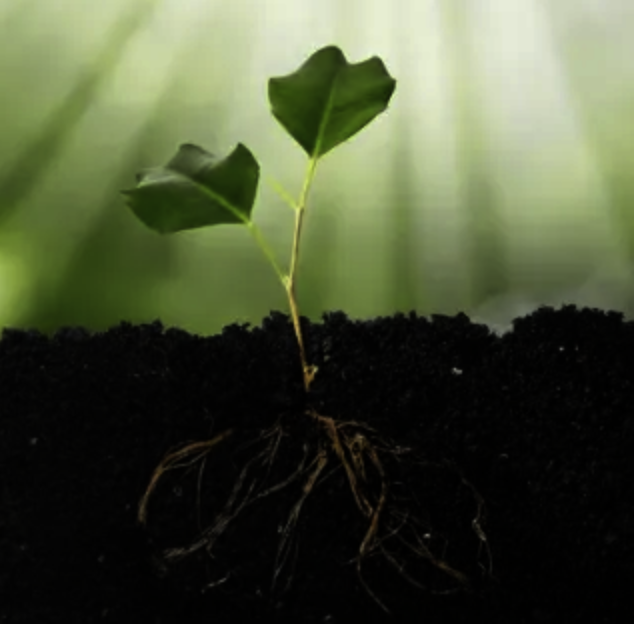
One of the things I’m learning about healthy soil is how much is happening that we cannot see. Above ground, we see the plant. Below ground is an entire world of roots, fungi, microorganisms, water, nutrients, organic matter, and networks of exchange and relationship among living things.
What happens above ground depends upon the health of what is happening below it.
Organizations have their own version of this invisible infrastructure. We tend to pay a lot of attention to what is above ground: KPIs, strategic plans, org charts, budgets, performance measures, products, and outcomes.
Underneath those things, though, are the less visible conditions that make them possible: trust, relationships, belonging, institutional memory, shared purpose, communication, psychological safety, informal networks, leadership capacity, and the ability to regulate ourselves during stress and uncertainty. There are also the people who quietly connect parts of an organization that don’t formally connect on an org chart, carrying information, history, relationships, and culture across boundaries.
Those things can be hard to measure. But that doesn’t make them less real, and it certainly doesn’t make them less important.
Maybe one of the biggest lessons I’m taking from regenerative agriculture is this:
You cannot separate what a system produces from the conditions that produce it.
That seems obvious when we’re talking about soil. I’m increasingly curious why we treat organizations differently.
Leadership as Stewardship
This way of thinking has also started changing how I think about leadership.
A farmer can’t command a seed to grow. They can’t force microorganisms to build healthy soil or schedule rain. What they can do is pay attention. They can learn their ecosystem, notice what is happening, experiment, tend, protect, and respond. They can work with the conditions to create the greatest opportunity for life to flourish.
What if leadership worked a little more like that?
The leader becomes less of a person who is supposed to control every outcome and more of a steward of conditions: someone who pays attention not only to what the organization is producing, but to the health of the system producing it.
That might mean noticing where energy is flowing and where it gets stuck. It might mean understanding that sometimes disturbance is necessary and sometimes the ground needs recovery. It might mean cultivating diverse perspectives and developing leadership in other people rather than creating dependence on a single person. It means tending relationships and growing deep roots before the storm arrives, not scrambling to create them once the storm is already here.
The question becomes less about how to control the system and more about how to understand and tend it.
What does this system need in order to become more alive, adaptive, connected, and capable of renewal?
I’m still learning what leadership looks like when we start from that question. But I’m increasingly convinced it is a question worth asking.
The Work I’m Moving Toward
So I find myself in an interesting place. My work is changing, and it isn’t.
I’m still interested in leadership development, organizational strategy and change, and how adults learn, develop, and transform. I’m still interested in the body, the nervous system, and the often-invisible patterns that shape how we behave.
What has changed is that I’m less interested in treating these as separate problems.
Individuals exist within bodies. People exist within teams. Teams exist within organizations. Organizations exist within communities. And all of them exist within larger living ecosystems.
Each layer influences the others, and none of these systems can remain healthy through extraction indefinitely.
That is why I’m moving more deeply into the study and practice of regenerative leadership and regenerative organizations. I don’t have all the answers here. In fact, part of what excites me about this work is how much I still have to learn.
But I do have a question.
It is the question I want to keep bringing into leadership conversations, strategic planning, organizational transitions, team development, and my own work:
What would allow this system to become healthier and flourish?
Not simply more productive. Not more efficient at the expense of its people. Not more resilient so it can tolerate increasing amounts of depletion and disruption.
I’m interested in what allows organizations to become healthier, more adaptive, more connected, more capable of learning, more able to grow the people within them, and more capable of renewal.
Maybe we can learn to tend organizations a little more like living systems. And maybe one measure of our leadership is not simply what the organization produced while we were there, but what we leave behind.
Is the soil richer because we were here?
